
Read this before you approve anything else this month.
Because right now, somewhere in your business, a campaign is being briefed, an ad is being signed off, a website page is being built, or an email is being scheduled. It will look fine. It will sound on-brand. Nobody in the approval chain will flag it. And the moment it goes live, it will disappear, taking your budget, your time and your message down with it.
I call that the Attention Tax. It’s not a fee anyone bills you for. It’s silence. And it doesn’t just hit your social posts. It’s collected across every channel you touch: your campaigns, your advertising, your website, your emailers. Almost every business pays it without ever realising.
The world got noisy. Then it got automated.
Back in 1997, Steve Jobs stood in front of an audience and warned that the world was already too noisy for people to remember much about any one brand. He was right, and that was before smartphones, social feeds, ad exchanges or AI existed.
Now every business has a printing press in its pocket, and it doesn’t stop at social content. Marketers are turning to Claude, Copilot and ChatGPT to draft campaign concepts, write ad copy, build landing page content and pump out emailers. It’s fast. It’s cheap. And on the surface, it looks like it’s working.
Here’s the problem. Ahrefs found 87% of marketers now use AI to help create content. When everyone reaches for the same tools trained on the same data, every touchpoint starts sounding the same, not just the posts. Researchers at the University of Washington, Carnegie Mellon and the Allen Institute for AI recently tested more than 70 language models against 26,000 real prompts and gave the pattern a name: the Artificial Hivemind. The output converges. The edges get smoothed off. What’s left is the median, dressed up as your brand voice, your headline, your subject line.
Consumers have noticed. Klaviyo’s 2026 AI Consumer Trends Report, based on 8,000 consumers across eight countries, found people are four times more likely to trust a brand less than more once they spot AI-generated content in its marketing. Separate research from SmythOS found half of consumers can now correctly identify AI-written content on sight.
This is the villain’s logic from The Incredibles, playing out across your marketing plan: when everyone is super, no one is. When every campaign, ad and email is built from the same average, average stops being safe. It becomes invisible.
The Attention Tax is being collected across every channel
Here’s what a safe, generic approach actually costs you, whether you notice it or not.
Campaigns and advertising. Attention has never been given. It’s earned, execution by execution, and a safe campaign simply doesn’t do the work to earn it. The IPA’s own databank, analysing more than 600 award-winning campaigns, found the average number of major business effects per campaign has fallen to its lowest point in the study’s 24-year history, as the industry chases short-term, safe activity over distinctive, long-term creative work. Fewer people remember it, fewer act on it, and by the time it shows up in the sales numbers, the campaign that caused it has long since ended.
Content and social. Hootsuite’s 2025 benchmarks put average organic reach on a Facebook business page at just 1 to 2%, down from around 16% in 2012. LinkedIn company pages fare a little better at roughly 4%, still a fraction of what real distinctiveness can pull in. That’s not a platform glitch. It’s the algorithm and the human brain doing exactly what they’re built to do: filtering out anything that doesn’t earn a second’s more attention than the post before it.
Websites. Landing pages built to a generic template convert at a fraction of the rate of ones built around one clear, distinctive proposition. HubSpot’s own data shows landing pages written at a plain, Year 8 reading level convert 23% better than pages overloaded with dense, corporate jargon. Bland doesn’t just fail to excite. It actively costs conversions.
Email. The average brand still treats the inbox as a broadcast channel. HubSpot found segmented, targeted email campaigns drive 30% more opens and 50% more click-throughs than generic, one-size-fits-all sends, and Campaign Monitor’s research shows personalised email delivers roughly six times the transaction rate of the generic version of the same send.
Most businesses feel all of this as a slow leak rather than a single loss. Fewer people notice the ad. Fewer click the email. Fewer convert on the landing page. Fewer of those become leads. Nobody connects the dots back to the safe brief that started it.
Distinctive costs the same. It just pays back more.
The flip side is where it gets interesting, because the data on what works is just as strong as the data on what doesn’t, in every channel.
In advertising, the IPA’s own research found that the most creatively consistent brands, the ones that commit to a distinctive idea and stick with it, are expected to grow market share more than twice as effectively over five years as the least consistent brands, for the same media spend. Kantar and WARC went further, showing genuinely creative, effective ads generate more than four times the profit of average work. On branding specifically, Ipsos-backed research shows campaigns that embed real distinctive brand assets see uplifts of at least 34%, with standout use of those assets driving up to 62% higher ROI than the campaign average. System1’s research on “fluent devices,” recurring characters and cues that make a brand instantly recognisable, found they outperform by 32% on measures like market share and profit.
In email, HubSpot and Campaign Monitor’s numbers say the same thing: personalisation and a distinctive voice aren’t a nice-to-have. They’re the difference between a message that gets deleted and one that gets read.
None of this costs more to produce than the safe version. It costs a different kind of thinking to produce.
Five triggers that earn attention, in every channel
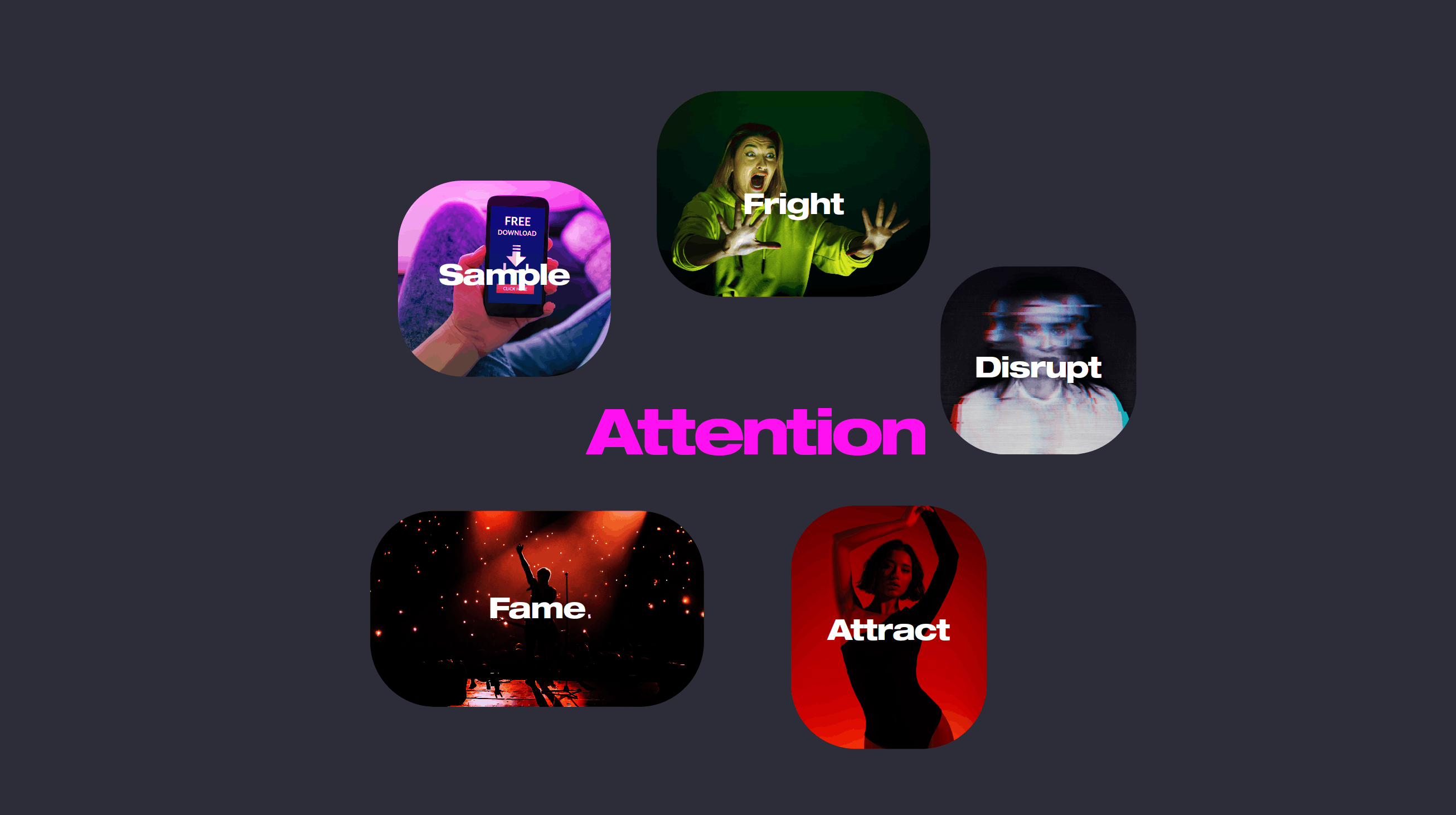
This is the part most AI-first marketing skips, because triggering genuine attention takes judgement, not just a prompt. We build every campaign, ad, page and email around five triggers.
Fright. Name a real, specific risk your audience already feels but hasn’t heard said out loud. Not manufactured fear. The thing they already worry about at 2am.
Disrupt. Make a genuinely counterintuitive claim, one specific enough that it stops someone mid-scroll, mid-inbox or mid-browse because it doesn’t match what they expected to see next.
Attract. Give people something they actively want to look at or read, not something they tolerate because it’s from a brand they follow or a list they’re on.
Fame. Borrow or build a reputation worth talking about. People share what makes them look sharp for having found it first.
Sample. Prove the claim in miniature. Show, don’t just tell, and let the proof do the persuading.
Run your next campaign, ad, landing page or email against those five before it goes anywhere near a sign-off. If it doesn’t clear at least one properly, it’s heading straight into the Attention Tax.
What to actually do about it
1. Audit your last quarter of output against the five triggers, across every channel. Pull your last few campaigns, ads, key landing pages and email sends. Be honest. If none of them clear a trigger, you’ve found your Attention Tax bill.
2. Give AI a job it’s good at, and keep the strategy human. Use it for drafts, research and speed across content, ad variations and email copy. Keep the point of view, the risk-taking and the final call with people who understand your brand and your market.
3. Build and protect your distinctive assets, everywhere they show up. A recurring character, a sonic cue, a visual style or a tone of voice nobody else in your category owns. Use it consistently across your ads, your website and your emails. This is where the 34 to 62% uplift comes from, and it compounds every time you use it.
4. Say the thing your competitors are too safe to say, in the channel that matters most. That’s not recklessness. It’s the Fright and Disrupt triggers doing their job, whether it’s a headline, an ad line or a subject line.
5. Measure honestly, channel by channel. If your organic reach, your landing page conversion or your email open rates look like the industry averages above, that’s not bad luck. That’s the tax. Use it as your baseline and hold every future campaign, page and send to beating it.
The businesses winning attention right now aren’t the ones with the biggest budgets or the newest AI tools. They’re the ones willing to be seen, disagreed with, and remembered, in every channel they use. Bland is comfortable. It’s also the only strategy guaranteed to lose.
In the land of the bland, the disruptive brand is king.