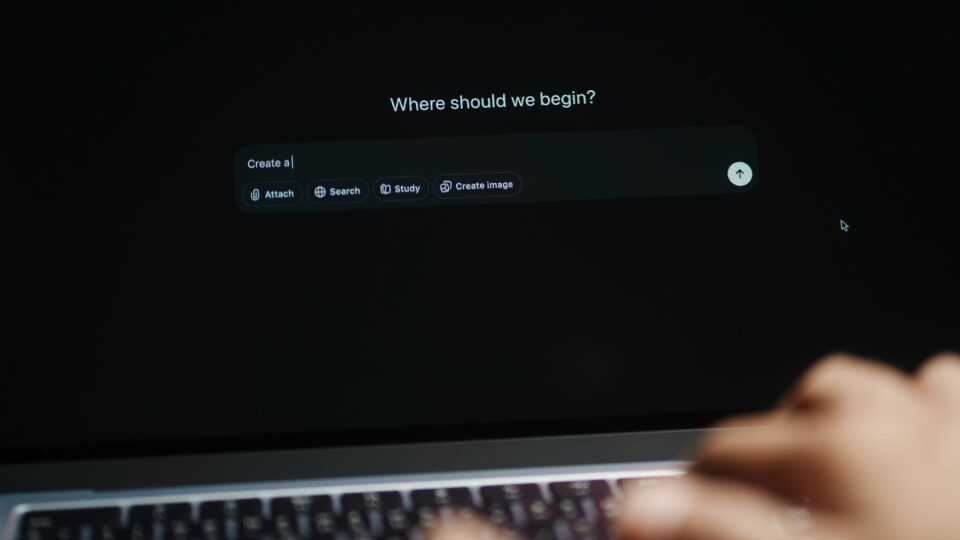
And why does it matter for your brand?
There’s a shift happening in how people find information online, and most brands haven’t caught up with it yet.
For the last two decades, the goal of search marketing has been simple: rank as high as possible on Google. Get to page one. Get to position one. Drive traffic to your site.
That goal hasn’t disappeared. But something significant is sitting alongside it now — and for many search queries, it’s sitting in front of it.
When someone asks ChatGPT which accounting software is best for growing businesses, or asks Perplexity to recommend a commercial solar provider in the UK, or asks Google’s AI Overview to explain the difference between two types of insurance policy — they’re not getting a list of ten blue links. They’re getting an answer. A direct, confident, single answer that names specific brands, cites specific sources, and leaves the user with little reason to scroll further.
The brands that get named in those answers are winning a new kind of visibility. The brands that don’t exist in those answers are becoming invisible to a growing share of their audience.
That’s what Answer Engine Optimisation is about.

AEO vs SEO: what’s the difference?
SEO: Search Engine Optimisation — is the practice of making your website rank well in traditional search results. It involves technical website health, keyword strategy, backlinks, content quality, and a hundred other factors that influence where Google places you in a list of results.
AEO: Answer Engine Optimisation — is the practice of making your brand, your content, and your expertise the source that AI systems draw on when they construct their answers.
The distinction matters because the mechanism is different. In traditional search, Google indexes your page and presents it as an option. In answer engines, the AI synthesises information from across the web and presents a conclusion. Your page might be one of dozens it has read. But only one or two brands will get named in the output.
Being indexed is no longer enough. You need to be cited.
How AI platforms decide who to name
ChatGPT, Perplexity, Claude, Gemini, and Google’s AI Overviews all work differently under the hood, but they share a common logic when it comes to which brands and sources they surface.
They look for consistency. A brand that appears repeatedly across credible sources — industry publications, third-party review sites, trade press, well-structured owned content — builds a stronger signal than a brand with a polished website and nothing backing it up elsewhere.
They look for clarity. Content that answers questions directly, in plain language, with a clear structure, is easier for AI to extract and use than content that buries its point in preamble or writes for keywords rather than humans.
They look for authority. Specific expertise, cited data, named authors with verifiable credentials, and content that demonstrates genuine depth all contribute to an AI’s confidence in a source.
They look for recency. Outdated content, inactive publishing, and brands that haven’t produced anything new for eighteen months are less likely to be treated as the current authority on a topic.
Put simply: AI platforms trust the brands that the rest of the internet already trusts. AEO is about building that trust in a way that AI systems can recognise and act on.
Five practical steps your brand can take now
1. Structure your content to answer real questions directly. Traditional SEO asks whether your page contains the right keywords. AI search asks whether your brand is a recognised, well-defined entity in the model’s understanding of your market. That recognition comes from consistency — the same brand, described in the same terms, appearing across multiple credible sources. A company that exists only on its own website is not well-recognised. A company with a coherent presence across LinkedIn, trade press, third-party directories, and structured web data is.
2. Build your presence beyond your own website. Being cited in the right trade publications, appearing on credible industry directories, getting coverage in relevant press — all of this creates the external signal that AI platforms use to validate your authority. Owned content alone is not enough.
3. Give your expertise a human face. Named authors, leadership commentary, published opinion pieces, and profiles that establish individual expertise all contribute to the trust signals AI systems respond to. Anonymous content has less weight than content that can be attributed to a specific, verifiable person.
4. Be consistent and current. Publish regularly. Update older content. Make sure your positions and credentials are current. An AI looking for the leading voice on commercial energy storage needs to find evidence that you’re still actively engaged in the conversation — not a case study from 2021.
5. Audit what AI currently says about you. Run your brand through ChatGPT, Perplexity, and Google’s AI Overview. Ask the questions your prospects are asking. See whether you appear, what you’re associated with, and whether the narrative is accurate. That audit tells you more about your current AEO position than any keyword ranking report.

This is where search is heading
AEO isn’t a replacement for SEO. A strong SEO foundation — fast, well-structured, authoritative content — still underpins both. But the search landscape has moved on, and the brands winning the next five years of organic visibility are the ones building for AI discovery now, not retrofitting in three years’ time when everyone else has caught up.
At Fireworx, we work with ambitious brands on the strategy, content, and digital presence that positions them to be cited, not just ranked. If you want to understand where your brand stands and what it would take to become the go-to answer in your sector, we’d like to talk.
Explore our AI and search marketing services
Email: ideas@fwx.co.uk or even better talk to a human on: 01202 559 559